
How to Measure Your Dachshund for a Harness (Step-by-Step)
August 22, 2026
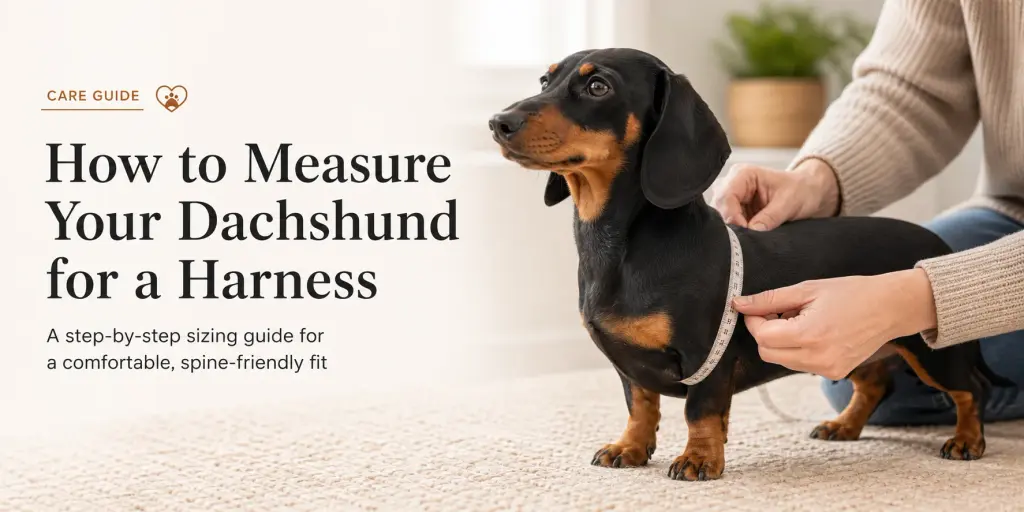
Dachshunds are built differently: a deep chest, short legs and a long back. That combination means standard "small dog" harness sizes almost never fit right. A harness that is too loose slips at the shoulders; one that is too tight presses on the ribcage and armpits.
Grab a soft tailor's measuring tape (or a piece of string and a ruler) and take three measurements with your dog standing up, not sitting.
1) Chest girth (the most important one)
Wrap the tape around the widest part of the ribcage, just behind the front legs. Keep the tape snug but not compressing. You should be able to slide two fingers flat under it.
Typical ranges: mini dachshund 30-40 cm (12-16 in), standard dachshund 40-55 cm (16-22 in).
2) Back length
Measure from the base of the neck (where a collar naturally sits) to the base of the tail. This tells you whether a harness panel will sit on the back comfortably or extend past the hips.
Typical ranges: mini 30-38 cm (12-15 in), standard 40-50 cm (16-20 in).
3) Neck girth
Wrap the tape around the base of the neck, where the harness strap will rest — lower than a collar. Two fingers of slack again.
Typical ranges: mini 22-30 cm (9-12 in), standard 30-40 cm (12-16 in).
4) Weight (a tiebreaker, not a size)
If your dog falls between two sizes on chest girth, weight helps decide. Growing puppies and dogs between sizes should size up and tighten the straps.
Quick sizing guide
- S: chest 30-38 cm (12-15 in), neck 22-28 cm (9-11 in) — mini dachshunds
- M: chest 38-46 cm (15-18 in), neck 27-33 cm (11-13 in) — large minis and small standards
- L: chest 46-55 cm (18-22 in), neck 32-40 cm (13-16 in) — standard dachshunds
Why the fit matters for the back
Dachshunds are a chondrodystrophic breed and are predisposed to intervertebral disc disease (IVDD). Pulling on a neck collar concentrates force on the cervical spine, so a well-fitted harness that spreads pressure across the chest is the safer everyday choice. Look for:
- A wide, padded chest panel instead of thin straps
- A Y-shaped front that leaves the shoulders free to move
- A back clip for daily walks (front clips can twist a long body)
- Adjustable straps on both the neck and the chest
Tips for an accurate measurement
- Measure over the coat your dog usually wears outside, not after a bath when the coat is flat.
- Have someone hold a treat in front so your dachshund stands square.
- Measure twice and use the larger number.
- Re-measure every 2-3 months for puppies, and after any weight change in adults.
Signs the harness does not fit
- Rubbing or bald patches in the armpits
- The harness rotates to one side during a walk
- You cannot fit two fingers under any strap, or you can fit four
- Your dog freezes, hops or refuses to walk while wearing it
Once you have your three numbers, compare them against the size chart on the product page before ordering. If your dachshund lands between two sizes, choose the larger one and adjust the straps in.